Welcome back to Trading Strategy Guides. If you have been banging your head against the wall using traditional retail trading methods—trendlines that get faked out, support levels that break just to trigger your stop loss, and moving average crossovers that lag the market—it might be time to look at how the institutions trade.
Today, we are diving deep into SMC entry models (Smart Money Concepts).
Smart Money Concepts are based on the idea that the financial markets are controlled by institutional players, banks, and hedge funds (the “Smart Money”). By understanding how these entities inject liquidity into the market, we can align our trades with their footprints. In this guide, we are going to outline exactly what an SMC entry model is, break down the core mechanics of top trading entry models, and give you the framework to build your own strategy.
Whether you are looking for a reliable SMC entry, or you are trying to compile notes for your own SMC entry model PDF, this guide will serve as your masterclass.
What Are Entry Models in Trading?
Before we get into the weeds of Smart Money Concepts, let’s define what we mean by entry models trading. An entry model is a strict, repeatable set of rules and conditions that must be met before you execute a trade.
Amateur traders trade based on feeling. Professional traders trade based on models.
When looking at various entry models trading strategies, the goal is always to find a setup that offers a high probability of success coupled with a strong Risk-to-Reward (R:R) ratio. Traditional models might rely on a Fibonacci retracement combined with a bullish engulfing candle. SMC entries, however, rely on price action mechanics: Liquidity sweeps, Order Blocks (OB), Fair Value Gaps (FVG), and Changes of Character (CHOCH).
The Building Blocks of an SMC Entry Model

To master any SMC entry model, you first need to understand the language of the Smart Money. You cannot spot the entry if you do not understand the setup. Here are the core pillars:
1. Market Structure (BOS and CHOCH) Structure is king. A Break of Structure (BOS) occurs when price successfully breaks and closes beyond a previous higher high (in an uptrend) or lower low (in a downtrend), indicating trend continuation. A Change of Character (CHOCH) is the first sign of a potential reversal—it happens when price breaks a minor structural point in the opposite direction of the prevailing trend.
2. Liquidity Pools Smart Money needs liquidity to execute their massive orders. They find this liquidity where retail traders place their stop losses—typically above equal highs (Buy-side Liquidity) or below equal lows (Sell-side Liquidity). Most SMC entry models begin precisely after liquidity is swept.
3. Order Blocks (OB) An Order Block is simply the last down-candle before a strong bullish move that breaks structure, or the last up-candle before a strong bearish move. It represents the footprint of institutional buying or selling.
4. Fair Value Gaps (FVG) An FVG (also known as an imbalance) is created when price moves so violently in one direction that buyers and sellers are not given an equal opportunity to transact. It leaves a “gap” in the price action consisting of three candles. The market naturally wants to return to these gaps to balance the price.
Top 3 SMC Entry Models Explained

Now that we have the vocabulary, let’s look at the actual trading entry models you can apply to the charts.
Model 1: The Liquidity Sweep to CHOCH Model
This is arguably the most popular SMC entry model because it traps retail traders while allowing you to enter with the institutions.
- The Sweep: Wait for price to approach a major high or low (a liquidity pool). Watch as price pierces this level, sweeping retail stop losses, but fails to close significantly beyond it.
- The CHOCH: Immediately after the sweep, look for a violent reaction in the opposite direction that breaks a recent, minor structural point. This Change of Character signals the institutions have stepped in.
- The Entry: Identify the Order Block or FVG that initiated the CHOCH. Place your limit order at the start of the OB or FVG, with your stop loss just past the extreme of the sweep.
This model is incredibly powerful because by the time you enter, the “Smart Money” has already manipulated the market and shown their hand.

Model 2: The Order Block Continuation (Trend Following)
While reversals are highly sought after, trading with the trend using SMC is often much safer. This entry model trading setup relies on a clear, established trend.
- Identify the Trend: Confirm higher highs and higher lows (bullish) or lower highs and lower lows (bearish). Wait for a clear Break of Structure (BOS).
- Locate the Institutional Footprint: Find the unmitigated Order Block that caused the BOS. For a valid OB, it should ideally have an FVG directly next to it—this proves the move had momentum.
- The Entry: Wait for price to pull back to the Order Block. As price taps into the OB, you execute your SMC entry. Stop loss goes behind the Order Block.
Model 3: The FVG Sniper Entry
Sometimes, the market moves so fast it doesn’t return to the Order Block. In these highly trending environments, we use the Fair Value Gap as our primary entry point.
- The Imbalance: Identify a massive displacement in price that leaves a clear FVG.
- The Entry: You place your entry order at the beginning (or the 50% mark) of the Fair Value Gap.
- Risk Management: This is slightly riskier than an OB entry, so stop losses are typically placed behind the candle that created the gap.

Risk vs. Confirmation: The SMC Confirmation Entry
If you spend time in trading forums, you will likely see people searching for an “smc confirmation entry pdf.” Why is this so specific? Because there are two ways to execute SMC entries: Risk Entries and Confirmation Entries.
The Risk Entry: You identify a Higher Time Frame (HTF) Order Block (e.g., on the 1-hour or 4-hour chart) and simply place a limit order there. You are risking that the HTF level will hold without waiting for extra proof.
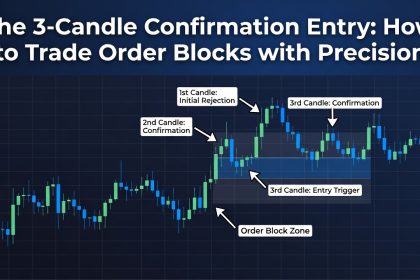
The SMC Confirmation Entry: This is how professionals protect their capital. Instead of blindly buying at a 4-hour Order Block, you wait for price to enter that 4-hour zone, and then you zoom in to a Lower Time Frame (LTF), like the 5-minute or 1-minute chart. Inside that HTF zone, you wait for the LTF to form its own mini Liquidity Sweep and CHOCH.
This multi-timeframe alignment is the holy grail of trading entry models. It allows you to use a 1-minute stop loss (giving you a massive Risk-to-Reward ratio) while riding a 4-hour trend.
Creating Your Own SMC Confirmation Entry Checklist:
If you are compiling your own SMC confirmation entry pdf, make sure it includes these strict steps:
- HTF Narrative: Is the daily/4H trend bullish or bearish?
- HTF Point of Interest (POI): Has price reached a major 4H Order Block or FVG?
- Patience: Wait for price to tap the POI. Do nothing until it does.
- LTF Shift: Drop to the 5m or 1m chart. Did price sweep liquidity into the POI? Did it create a CHOCH?
- Execution: Enter on the LTF Order Block that caused the CHOCH.

Why Traders Search for an SMC Entry Model PDF
We see the search term “smc entry model pdf” constantly. Traders are desperately looking for a downloadable cheat sheet that will instantly make them profitable.
While reading a PDF guide is great for studying offline, the reality is that the best SMC entry model PDF is the one you create yourself.
Trading is a visual and psychological endeavor. Taking screenshots of your winners and your losers, annotating them, and building your own playbook is what separates profitable traders from those who blow accounts. We highly recommend at Trading Strategy Guides that you take the models outlined in this article, backtest them on TradingView, and compile them into your own digital journal or PDF.
Documenting your entry models trading rules ensures that when the market is moving fast and emotions are high, you have a physical set of rules to keep you disciplined.
Final Thoughts on Smart Money Concepts
Mastering SMC entry models takes time, patience, and a lot of chart time. It requires you to stop looking at the market as a series of random wiggles, and start looking at it as an ongoing battle for liquidity.
To summarize, a high-probability SMC entry requires:
- An understanding of the Higher Time Frame narrative.
- A clear draw on liquidity.
- A predefined Point of Interest (OB or FVG).
- Patience to wait for a Lower Time Frame confirmation (CHOCH).
Whether you prefer the risk entry for its simplicity or the SMC confirmation entry for its surgical precision, incorporating Smart Money Concepts into your trading arsenal is one of the fastest ways to elevate your edge in the markets.
Stop trading where the retail crowd trades. Wait for the manipulation, look for the institutional footprint, and execute your model without hesitation.
Would you like me to outline a step-by-step backtesting routine so you can start practicing these SMC entries on historical data?