- The Problem: Why “Limit Orders” Are Killing Your Win Rate
- Anatomy of the 3-Candle Formation
- Candle 1: The Attack (The Approach)
- Candle 2: The Reaction (The Tap)
- Candle 3: The Confirmation (The Reversal)
- 1. The Engulfing Confirmation (The “A-Shape” Reversal)
- 2. The Pin Bar / Liquidity Sweep Entry
- 3. The Inside Bar Breakout (The Low Volatility Entry)
- The Strategy: Step-by-Step Execution
- Step 1: Higher Timeframe (HTF) Narrative
- Step 2: Identify the POI (Point of Interest)
- Step 3: Drop to the Entry Timeframe
- Step 4: Wait for the 3-Candle Setup
- Step 5: Execute and Manage
- Advanced Tip: Blending Candles
- When to INVALIDATE the Entry
- Conclusion: Trading is about Reaction, Not Prediction
Category: Smart Money Concepts / Price Action Reading Time: 12 Minutes
If you have been trading Smart Money Concepts (SMC) for any length of time, you have likely experienced the frustration of the “Touch Trade.”
You identify a perfect Order Block. You mark your zone. You set a limit order at the 50% equilibrium point. And then, the market rips right through your zone, stopping you out instantly, only to reverse ten minutes later and go exactly where you predicted.
This is the curse of the “Risk Entry.”
While Order Blocks tell you where the market is likely to reverse, they do not tell you when. To fix your win rate, you need to stop guessing and start waiting for proof. You need a Confirmation Entry.
In this guide, we are going to bridge the gap between institutional structure and retail price action. We will break down the 3-Candle Confirmation Setup—a specific mechanical trigger that allows you to validate an Order Block before you ever risk a dollar.
The Problem: Why “Limit Orders” Are Killing Your Win Rate
Before we dive into the specific pattern, we need to address the psychology of the entry.
In classic SMC teaching, traders are often told to set a “Set and Forget” limit order at an unmitigated Order Block (OB).(If you are new to Order Blocks, read our complete guide here: Lecture 7 – How to Mark Order Blocks Correctly
The problem with “Set and Forget” is that it ignores the approach. Is price approaching your zone slowly, implying a correction? or is it crashing into your zone with high-impact news momentum?
A “Risk Entry” (Limit Order) assumes the zone will hold. A “Confirmation Entry” waits for the market to prove the zone is holding.
By waiting for the 3-Candle Confirmation, you may sacrifice a few pips of entry price (getting in slightly later), but you gain massive advantages:
- Higher Win Rate: You avoid losing trades where price smashes through the zone.
- Mental Clarity: You aren’t anxious about whether the level will hold.
- Data-Driven: You are trading reaction, not prediction.
Anatomy of the 3-Candle Formation
The 3-Candle Confirmation is not a specific Japanese candlestick name (like a Doji or Hammer). It is a sequence of price delivery. It tells a story of momentum shifting from one side of the market to the other.
It consists of three distinct phases, represented by three candles:
Candle 1: The Attack (The Approach)
This is the candle that enters your Point of Interest (POI) or Order Block.
- Characteristics: It should be moving against your trade direction. If you are looking to sell, this is a bullish candle moving up into the supply zone.
- Psychology: This represents the “dumb money” or late retail traders chasing price into a trap. It also represents the liquidity seeking the Order Block.
Candle 2: The Reaction (The Tap)
This is the most critical candle. It is the candle that interacts with the deepest part of the zone and fails to close beyond it.
- Characteristics: It often has a long wick (rejection) or a small body (deceleration).
- Psychology: The orders sitting in the Smart Money Order Block are absorbing the incoming volume. Buying pressure is drying up.
Candle 3: The Confirmation (The Reversal)
This is your trigger candle. It moves in your intended trade direction and closes strongly.
- Characteristics: It must close past the open of Candle 2 (and ideally Candle 1).
- Psychology: The institutions have finished building their position and are now pushing price away. The hand has been revealed.
Here is the example on a chart:
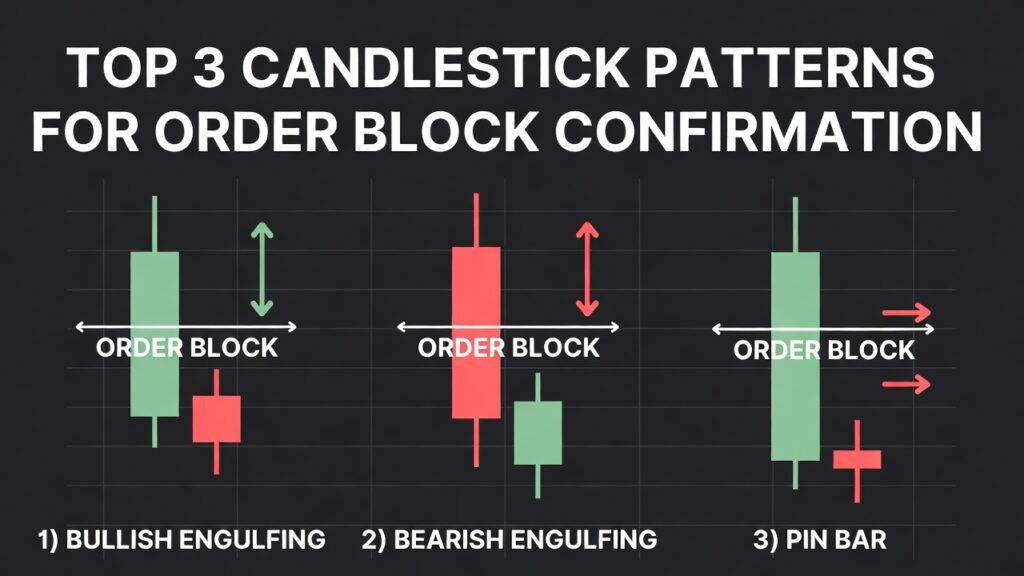
Now, let’s get specific. You likely know your candlestick patterns, but context is everything. A “Hammer” in the middle of nowhere is noise. A “Hammer” inside a Higher Timeframe Order Block is a weapon.
Here are the three specific variations of the 3-Candle Entry you should look for inside your zones.
1. The Engulfing Confirmation (The “A-Shape” Reversal)
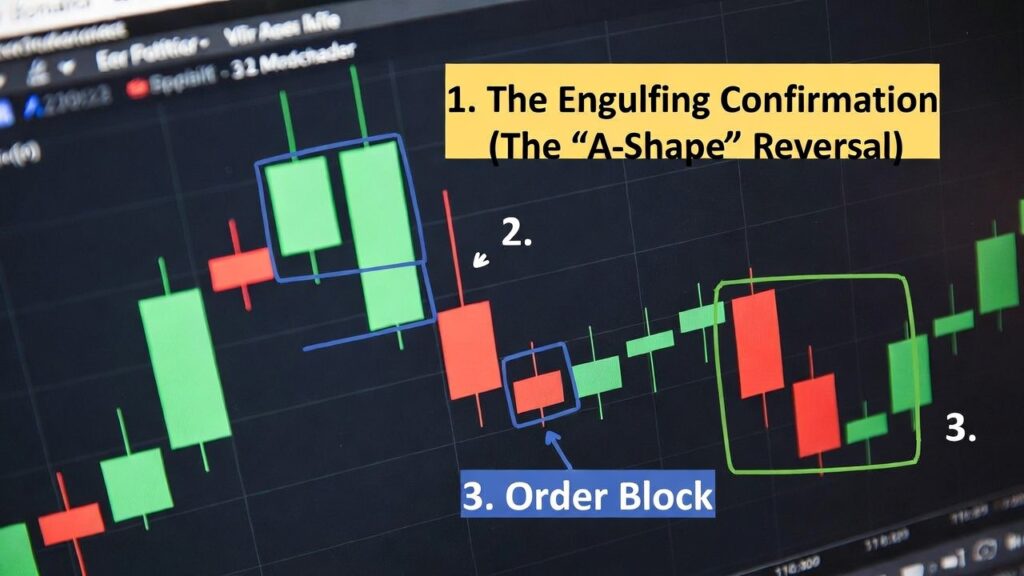
This is the highest probability setup.
- The Setup:
- Price taps into a Bearish Order Block.
- The “Reaction Candle” is a small bullish candle or a doji.
- The “Confirmation Candle” is a massive bearish candle that completely overlaps (engulfs) the body of the previous candle.
- The Entry: You enter immediately on the Close of the Engulfing Candle.
- The Stop Loss: Placed just above the wick of the Engulfing Candle (or the zone high).
Why it works: The Engulfing candle creates a new, smaller “Breaker Block” or supply zone instantly. It proves that sellers have completely overwhelmed buyers.
2. The Pin Bar / Liquidity Sweep Entry

This setup is common during “Stop Hunts” or “Judas Swings,” specifically during the London or New York Open.
- The Setup:
- Price aggressively pushes into your Order Block.
- The “Reaction Candle” pushes deep into the zone, perhaps even poking slightly above it, but then snaps back violently, leaving a long wick.
- The candle closes near its bottom (for a sell).
- The Entry: You can enter on the close of the Pin Bar itself, OR wait for the next candle to break the low of the Pin Bar.
- The Stop Loss: Above the wick.
Why it works: The long wick indicates a “Liquidity Sweep.” Smart Money utilized the liquidity above the previous high to fill their sell orders. The rejection is the footprint of that transaction.
3. The Inside Bar Breakout (The Low Volatility Entry)
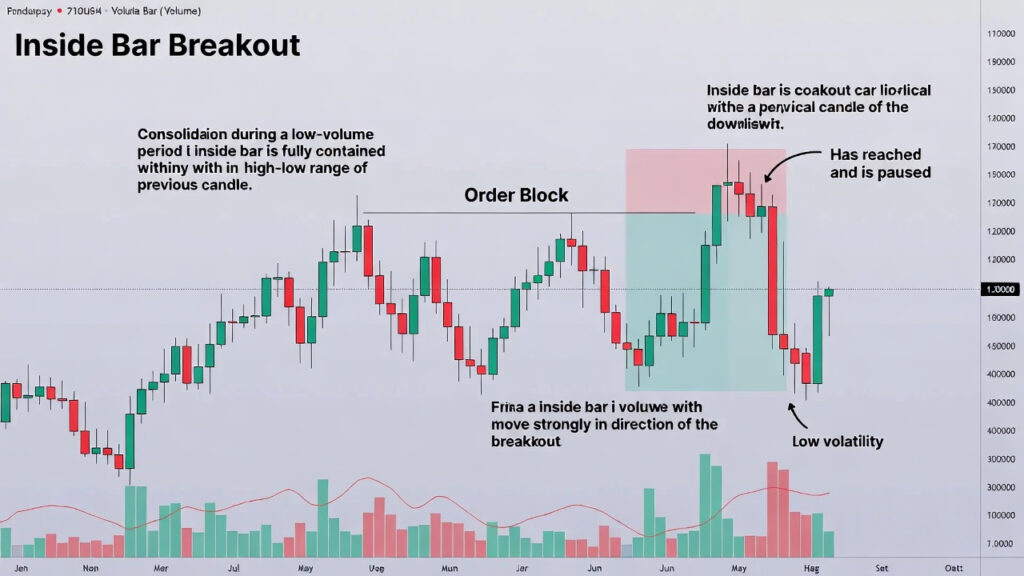
This is a consolidation entry, often seen when price reaches an Order Block during lunch hours or low volume, before a big expansion.
- The Setup:
- Price enters the zone.
- The “Reaction Candle” is large.
- The next candle (or multiple candles) stays completely inside the range of the previous candle. The market pauses.
- Confirmation: A subsequent candle breaks out of this small consolidation in your direction.
- The Entry: On the breakout of the “Mother Bar” (the large reaction candle).
The Strategy: Step-by-Step Execution
You cannot just trade every 3-candle pattern you see. You must follow a strict algorithm. Here is the checklist to stick to your monitor.
Step 1: Higher Timeframe (HTF) Narrative
Identify the trend on the 4-Hour or Daily timeframe. Are we bullish or bearish?
- Rule: Only look for Buy Confirmations in Discount (Oversold) zones.
- Rule: Only look for Sell Confirmations in Premium (Overbought) zones.
Step 2: Identify the POI (Point of Interest)
Mark your Order Blocks. Ensure they are valid.
- Does the OB have a Fair Value Gap (Imbalance)?
- Did the OB break structure (BOS)?
- Is there Inducement (liquidity) sitting just before the OB?(See Lecture 9: Inducement and Trapping for more on this).
Step 3: Drop to the Entry Timeframe
Once price taps your HTF Order Block (e.g., the 1-Hour OB), do not enter yet. Drop down to your “Execution Timeframe.”
- If POI is 4-Hour -> Look for entry on 15-Minute.
- If POI is 15-Minute -> Look for entry on 1-Minute or 5-Minute.
Step 4: Wait for the 3-Candle Setup

Patience is the hardest part. Watch price interact with the zone.
- If price blows through the zone without pausing? Delete the setup. You just saved yourself a loss.
- If price stalls and forms an Engulfing, Pin Bar, or Morning/Evening Star pattern? Prepare the trade.
Step 5: Execute and Manage
- Entry: Market execution on the Close of the 3rd candle.
- Stop Loss: Aggressive (Above the candle pattern) or Conservative (Above the whole Order Block).
- Take Profit: Target the next opposing Liquidity Pool (recent Lows/Highs) or the next opposing Order Block.
Advanced Tip: Blending Candles
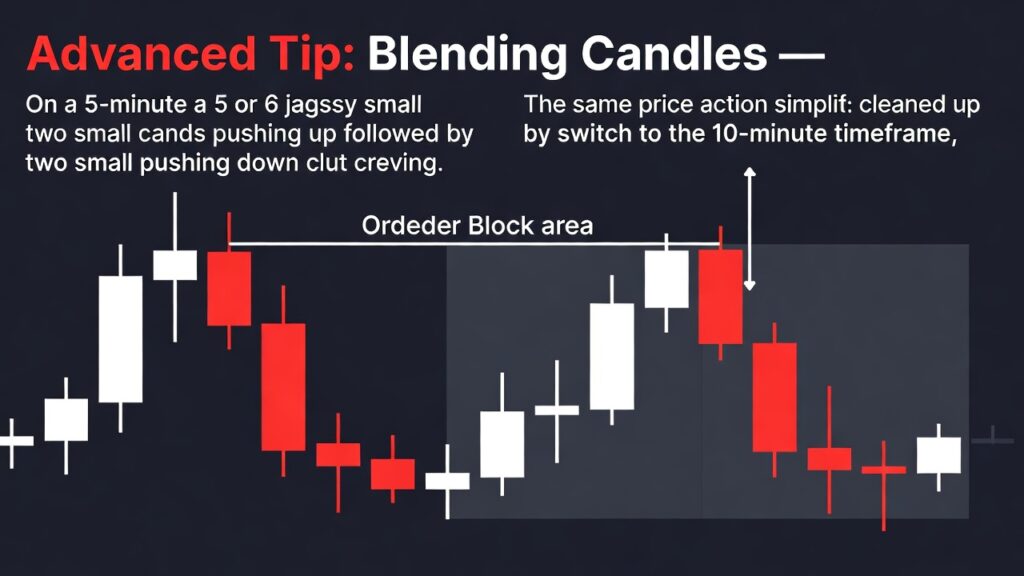
Sometimes the chart looks messy. You might see 5 or 6 jagged candles instead of a clean 3-candle pattern.
Technique: Use “Blended Candles.” If you are watching the 5-minute chart and see two small candles pushing up and two small candles pushing down, switch to the 10-minute timeframe.
Often, what looks like noise on the M5 is a perfect “Pin Bar” or “Engulfing” on the M10 or M15.
The Golden Rule of Timeframes: The higher the timeframe of the confirmation, the higher the strike rate, but the wider the Stop Loss.
- 1-Minute Confirmation: High Risk / Massive Reward (Tight Stop).
- 15-Minute Confirmation: Lower Risk / Moderate Reward (Wider Stop).
When to INVALIDATE the Entry
Not all 3-candle patterns are valid. Avoid taking the trade if:
- News Impact: It is 8:30 AM EST (NFP or CPI release). Volatility ignores candlestick patterns.
- Against Main Trend: If the Daily is extremely Bullish, looking for a 1-minute sell confirmation is essentially stepping in front of a freight train.
- No Inducement: If price hasn’t swept any liquidity before hitting the Order Block, the Order Block itself is likely the liquidity. Expect it to fail.
Conclusion: Trading is about Reaction, Not Prediction
The transition from “Retail Trader” to “Smart Money Trader” isn’t just about drawing Order Blocks; it’s about discipline.
A Limit Order is a prediction: “I predict price will turn here.” A Confirmation Entry is a reaction: “Price has turned here, and I am joining the move.”
By combining the structural edge of Order Blocks with the tactical precision of Candlestick Patterns, you create a trading plan that is defensive first and aggressive second.
Next Steps:

- Open your charts and find 10 examples of valid Order Blocks.
- Drop to the lower timeframe and see what candle pattern formed right at the reversal.
- Notice how many “failed” Order Blocks never gave you a 3-Candle confirmation (saving you money).
Ready to master the next step? Now that you have your entry, you need to understand how to manage the trade when the market shifts. Read our guide on [Lecture 10: Entry Models and Risk Entries] to refine your execution further.