Today in crypto, a crypto-aligned political action committee pulled back from a major ad push in a key Texas Senate race, signaling growing friction between digital asset interests and traditional party leadership. Polish prosecutors are investigating Zondacrypto over alleged fraud and access to funds, while local media report that CEO Przemysław Kral is in Israel. Meanwhile, decentralized finance protocols are coordinating efforts to restore rsETH following the $293 million Kelp DAO.
Crypto PAC pulls back from Texas Senate ad buy
A crypto-backed political action committee is reportedly stepping away from a major ad push in a key US Senate race, highlighting early friction between digital asset money and traditional party politics.
The Fellowship PAC, which launched with claims of more than $100 million in crypto-aligned backing, had disclosed $1.75 million in ad spend supporting Texas Attorney General Ken Paxton in his Republican runoff bid.
The expenditure, filed with the Federal Election Commission through marketing firm Nxum Group, was reportedly never executed. Despite that, the filing remained publicly visible, raising questions about how and why the reversal happened after it had already been disclosed.
According to reports, Republican leaders raised concerns about the PAC’s involvement and its ties to Howard Lutnick and Cantor Fitzgerald, which has partially funded Fellowship. The scrutiny appears to have played a role in the group backing off — an unusual move in a space where crypto PACs typically double down on their supported candidates.
Fellowship PAC expenditure report. Source: FEC
Zondacrypto CEO goes off radar as Poland probe deepens
Zondacrypto’s crisis deepened on Friday after Polish outlet Onet reported that CEO Przemysław Kral had gone to Israel as prosecutors investigate the exchange over alleged fraud and investor losses.
According to the report, Kral has been in Israel for about a week and holds Israeli citizenship, a factor that could complicate any potential extradition to Poland. Polish authorities opened an investigation into Zondacrypto last Friday over alleged fraud and investor losses. Cointelegraph also confirmed that Kral’s email address, previously used to communicate with him, has become unavailable.
The developments come a week after Kral admitted last Thursday that Zondacrypto’s cold wallet holding 4,500 Bitcoin (worth around $350 million) was inaccessible, marking his last publicly known communication at the time of reporting. Polish prosecutors have identified several hundred possible victims and potential losses of at least 350 million Polish zloty (around $97 million), according to Notes from Poland, citing prosecutor spokesperson Michał Binkiewicz.
The case has added pressure to one of Central and Eastern Europe’s biggest crypto platforms, even as Zondacrypto is much smaller in scale than global exchanges such as Binance.
The controversy deepened this week amid resignations from the supervisory board of BB Trade Estonia OÜ, the Estonian company that operates the exchange.
In a Monday post on LinkedIn, former board member Georgi Džaniašvili said the board learned about the scale of the Zondacrypto crisis through media reports rather than internally. He also pointed to “material inconsistencies” between public statements and information available to the board.
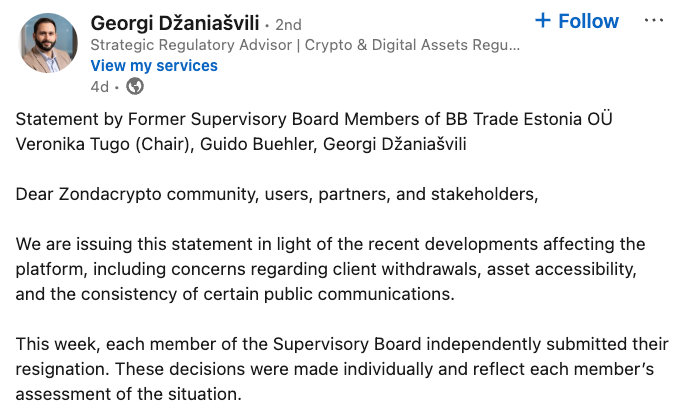
Source: Georgi Džaniašvili
Crypto protocols pledge 43K ETH to restore rsETH backing
Decentralized finance protocols have banded together in an attempt to restore the backing of rsETH following the $293 million exploit of the Kelp restaking platform on Saturday, which has triggered a liquidity shock.
The amount pledged has now exceeded 43,500 Ether, worth over $101 million, which decentralized lending platform Aave has called the “DeFi United” relief effort. Crypto protocols involved include Lido DAO and the Golem Foundation, with the largest pledges coming from the EtherFi Foundation and Mantle at the time of writing.
“We believe ecosystem collaboration matters most in moments like this, and our priority is achieving the strongest possible available outcome for users, said Aave on Thursday.
“Multiple strong indicative commitments are now in place to join this effort toward restoring the backing of rsETH.”
Hackers stole 116,500 Kelp DAO Restaked ETH tokens on April 18 from Kelp DAO’s LayerZero-powered bridge, then used them as collateral on Aave v3 to borrow wrapped Ether, resulting in about $195 million in bad debt on Aave, which has impacted the interconnected crypto lending market.
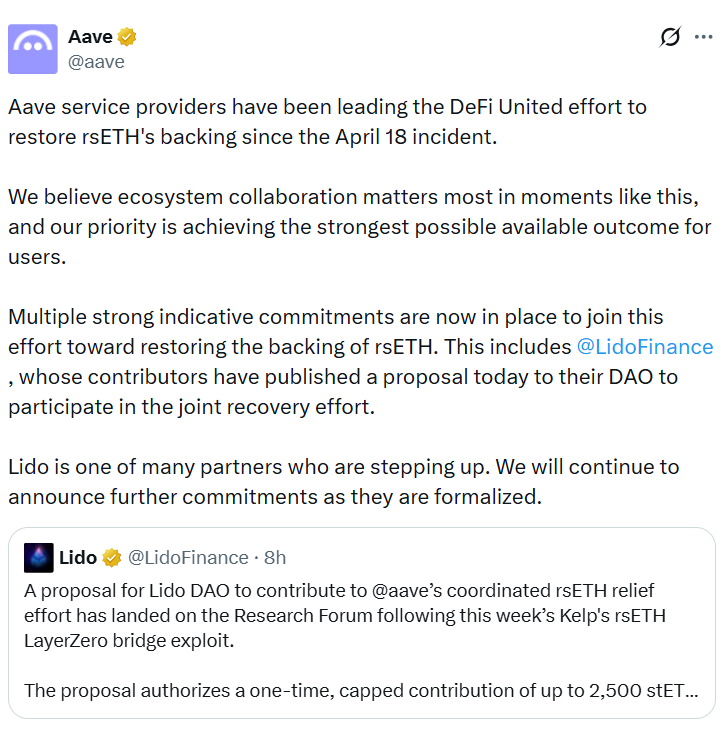
Source: Aave